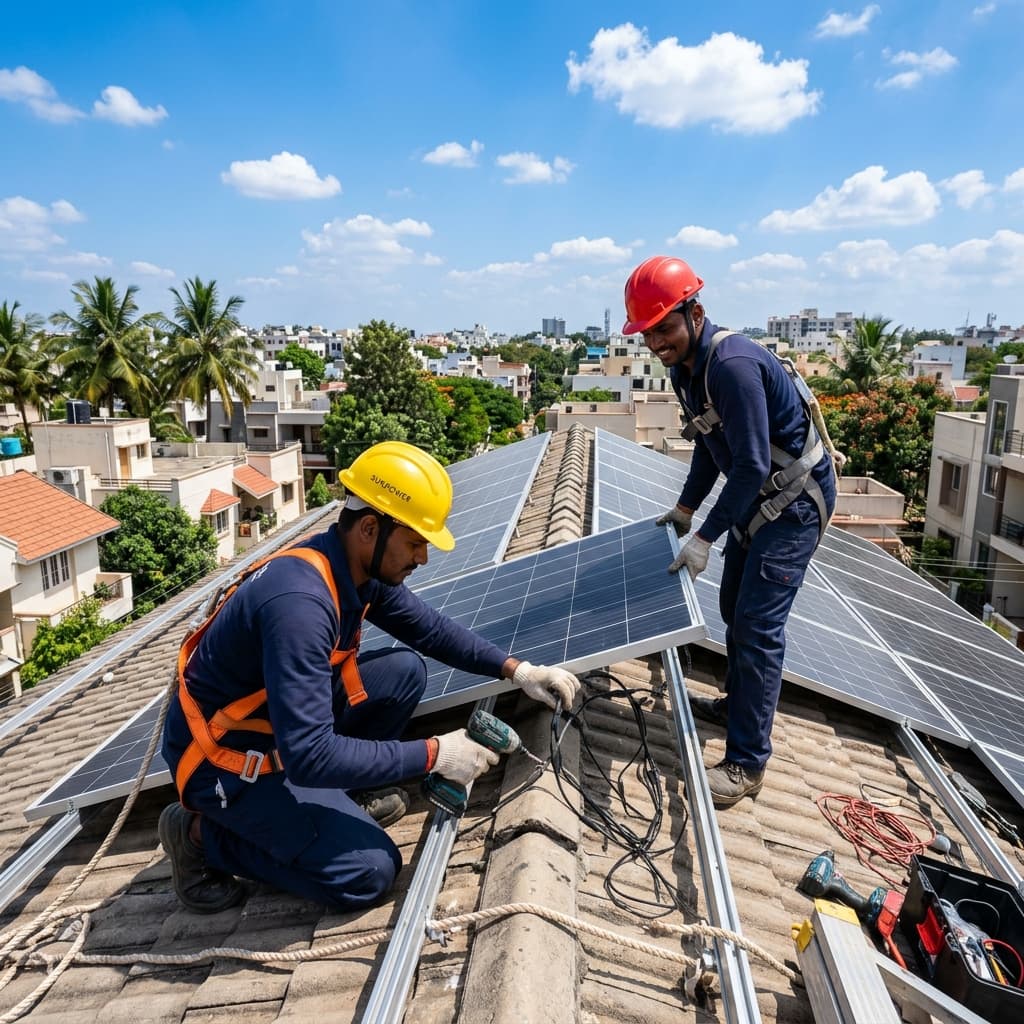
Maximizing Solar Inverter Efficiency: 5 Proven Maintenance Tips
Kiran Raj(Senior Renewable Energy Technician, Qpoint Systems)
•
May 02, 2026
•
6 min read
Discover how regular panel cleaning, proper wiring checks, and smart charge controller settings boost your rooftop solar power generation by up to 25%.
Solar installations represent significant clean-energy investments for Bangalore residences and commercial rooftops. Yet, environmental dust accumulation, thermal inverter throttling, and improper charge controller settings regularly degrade generation efficiency by 20% to 35%.
Follow these 5 field-tested maintenance guidelines from certified solar technicians to maximize your daily kilowatt-hour harvesting.
1. Maintain Solar Panel Soiling Below 3%
Airborne dust, vehicular emissions, pollen, and bird droppings create an opaque barrier across photovoltaic glass surfaces.
Cleaning Frequency: Wash panels early in the morning every 15 days using demineralized water and a soft microfiber mop.
Avoid Midday Cleaning: Spraying cold water onto scorching midday panel glass risks thermal shock micro-fractures in solar cells.
Efficiency Impact: Consistent bi-weekly cleaning immediately restores up to 12% in daily generation.
2. Optimize Solar Inverter Thermal Dissipation
Solar inverters are heavy power-electronic converters. When internal heatsink temperatures rise above 45°C during hot summer afternoons, smart inverters automatically throttle DC conversion output to safeguard internal IGBT switching circuits.
Install inverters in shaded, well-ventilated, weather-protected locations away from direct afternoon sun.
Maintain at least 30 cm clearance around heat sinks and cooling fans.
Periodically clean intake filters and vents to dislodge accumulated urban dust.
3. Upgrade from PWM to MPPT Solar Charge Controllers
Older solar hybrid inverters rely on Pulse Width Modulation (PWM) technology, which forces solar panel voltage down to the battery's chemical terminal level, discarding excess solar panel voltage as wasted heat.
Maximum Power Point Tracking (MPPT): Continuously calculates the optimal voltage and current equilibrium curve.
Performance Gain: Delivers 20% to 30% more energy into your battery banks, especially during overcast monsoon months and low-light mornings in Karnataka.
4. Minimize Low-Voltage DC Cable Transmission Losses
In 12V and 24V solar setups, long wiring runs can dissipate significant energy as resistive heat.
Always use UV-stabilized, high-grade cross-linked polyethylene (XLPO) solar DC copper cables.
Maintain wire cross-sections of at least 4 sq mm to 6 sq mm for runs under 15 meters to keep total DC voltage drop below 2%.
5. Calibrate Bulk and Float Voltage Cutoffs
Improper charging limits prevent tubular or lithium solar batteries from reaching full saturation.
Set Bulk Absorption Voltage to 14.4V - 14.6V per 12V lead-acid unit.
Set Float Voltage to 13.6V - 13.8V to avoid electrolyte boil-off during intense Bangalore summer sunshine hours.
Authorized Bangalore Service Hub
Need Doorstep Inverter or Battery Sizing?
Our technicians provide on-site electrical load calculation, genuine branded battery delivery, and same-day installation across Bangalore.